Roadmap OS vs airfocus: An Honest Comparison
Quick verdict
airfocus is a strong, mature roadmapping tool with excellent prioritization frameworks and a polished UI. It's a great fit for established mid-market product teams in Europe with ~10 stakeholders and a budget that can absorb per-user pricing. Roadmap OS is an all-in-one PM platform that combines roadmap, capacity, plans, products, prioritization, GTM checklists, and feedback in one workspace. It's a fit for small-to-mid teams who want one tool instead of five, especially teams in emerging markets, or teams shipping hardware. Switch from airfocus to Roadmap OS if:- You're paying €49/user/mo and the math doesn't work for your team size
- You also need capacity planning (airfocus doesn't have this)
- You ship hardware products
- You want a desktop app
- You're paying separately for a feedback tool, capacity tool, or project planner
- Your team is deeply into the airfocus prioritization workflow (it's genuinely strong)
- You don't need capacity planning
- Your enterprise procurement requires SOC 2 Type II (Roadmap OS is Type 1; Type 2 in progress)
Feature comparison
| Feature | Roadmap OS | airfocus |
|---|---|---|
| Starting price | $0 (free tier) | €49/user/mo (no free tier) |
| Standard tier | $17/mo (whole team) | €89/user/mo |
| Roadmap (Gantt + Kanban) | ✅ Both views, same data | ✅ Multiple views |
| Now/Next/Later | ✅ | ✅ |
| Prioritization frameworks | ✅ 6 (RICE, ICE, MoSCoW, Kano, Cost of Delay, Value-Effort) | ✅ Excellent — flexible scoring |
| Capacity planning | ✅ CapacityIQ — built-in | ❌ Not available |
| Project planner (WBS) | ✅ Plans module — 4 views, dependencies, 200+ templates | ❌ |
| Product profiles | ✅ Full lifecycle, release notes, bug tracker | ❌ |
| Hardware specs (BOM, firmware, certifications) | ✅ | ❌ |
| GTM checklists | ✅ | ❌ |
| Feedback portal | ✅ Public form + voting | ✅ Strong |
| Reports & dashboards | ✅ | ✅ |
| Audit log | ✅ Roadmap Change Log | ✅ |
| Desktop app | ✅ Mac/Windows/Linux | ❌ |
| Offline-capable | ✅ | ❌ |
| Integrations | 5 (Jira, GitHub, Slack, Asana, Linear) | 10+ |
| AI features | ✅ Pro tier — BYO API key | ✅ |
| Custom workflows | ⏳ Coming Q3 2026 | ✅ |
| Public roadmap embed | ⏳ Coming Q2 2026 | ✅ |
| API access | ⏳ Coming Q3 2026 | ✅ |
| Native ZAR / KES support | ✅ | ❌ |
| Paystack billing | ✅ | ❌ |
| Languages | English (more coming) | English, German |
| SOC 2 | Type 1 (Type 2 in progress) | Type 2 |
Pricing breakdown
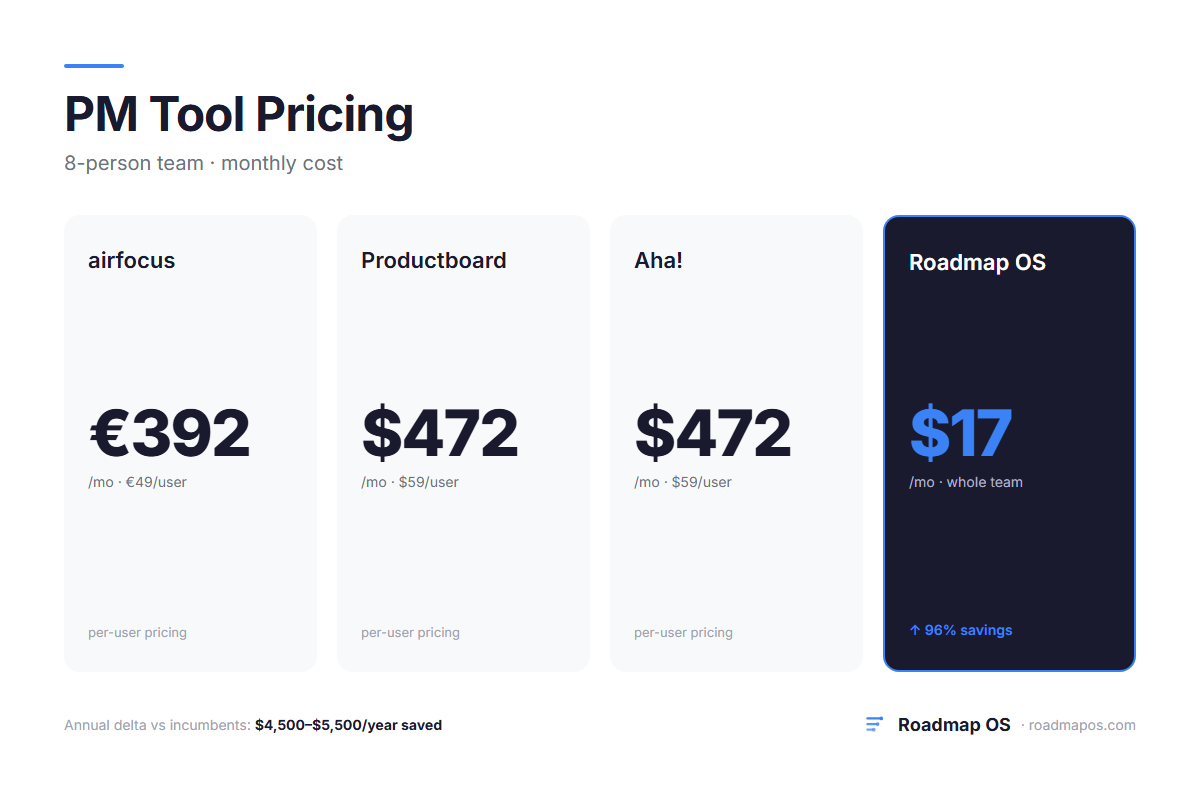
For a team of 8 (1 PM, 4 engineers, 1 designer, 2 stakeholders):| Plan | airfocus | Roadmap OS |
|---|---|---|
| Cheapest plan that fits | Advanced — €49/user × 8 = €392/mo (~$420 USD) | Standard — $17/mo total team |
| Annual cost | €4,704 | $204 |
For a team of 20, that becomes ~$11,000/year saved.
That said: airfocus's "Pro" tier on per-user pricing buys you mature workflows, Salesforce integration, and a more battle-tested platform. The price difference reflects different stages.
Where airfocus wins
Honest list. We don't compete by lying.
1. Prioritization sophistication
airfocus's prioritization is genuinely best-in-class. Custom scoring, weighted criteria, drag-and-drop comparison views. If your team's primary use case is "rigorously score 50+ initiatives across 8 weighted dimensions," airfocus is a better fit than Roadmap OS today.
Roadmap OS has 6 frameworks built in. They cover 90% of cases. They don't yet support fully custom weighted scoring.
2. Salesforce integration
If your sales-driven roadmap workflow depends on Salesforce opportunity data flowing into prioritization, airfocus has this. Roadmap OS doesn't (yet).
3. Maturity
airfocus has been shipping since 2018. They have enterprise references, SOC 2 Type 2, and a polish that comes from 7 years of iteration. Roadmap OS launched 18 months ago. We're shipping fast but we're younger.
4. Workflow customization
airfocus lets you build deeply customized workflows per workspace. Roadmap OS is more opinionated — there's a "right way" to use it. For teams that need extreme customization, airfocus is more flexible.
Where Roadmap OS wins
1. Pricing model
Total-team pricing ($17/mo whole workspace) is fundamentally different from per-user pricing (€49/user/mo). At team sizes >5, the math is dramatic.
For emerging market teams, this isn't a "nice optimization." It's the difference between affording the tool and not.
2. Capacity planning built in
airfocus doesn't do capacity planning. It's a deliberate scope choice on their part — they're a roadmap-first tool, and they expect you to use a separate capacity tool (or a spreadsheet).
Roadmap OS includes CapacityIQ — daily, weekly, monthly, quarterly, yearly views of team and individual utilization. Right next to the roadmap. This is the feature I cared about most when building Roadmap OS, because missing capacity is what cost me the most deadlines.
If you don't need capacity planning, this isn't a Roadmap OS advantage. If you do, it's a major one.
3. Plans module (project planner)
Roadmap OS has a real WBS-style project planner with task hierarchies, dependencies, four views, and 200+ templates. airfocus doesn't have this — they expect you to use Asana, Jira, or similar for delivery.
For small teams that don't want to maintain both a roadmap tool and a separate project planner, this is a significant scope advantage.
4. Hardware product support
Roadmap OS has product profiles with hardware-specific fields: BOM, firmware version, hardware revision, certifications with expiry dates, units shipped, failure rate, MTBF. airfocus is software-only.
If you ship hardware, this matters.
5. Desktop app
Roadmap OS ships a desktop app for Mac/Windows/Linux from the same codebase as the web app. Offline-capable. airfocus is web-only.
For teams in regions with intermittent connectivity, this is non-trivial.
6. Founder support
I personally onboard most paying customers. Email [email protected] and I'll reply, usually within 24 hours.
Who should pick which?
Pick airfocus if:
- You're a mid-market or enterprise team (50+ people)
- Your primary use case is sophisticated prioritization (heavy custom scoring, weighted criteria)
- You already have a project planner (Asana, Jira) and a capacity tool (or don't need one)
- Salesforce integration is mission-critical
- Per-user pricing fits your budget
- You need SOC 2 Type 2 today
Pick Roadmap OS if:
- You're a small-to-mid team (5-50 people)
- You want one tool instead of five (roadmap + capacity + plans + feedback + GTM)
- You ship hardware or hardware+software
- Per-user pricing is a budget problem
- You're in an emerging market and need ZAR/KES/Paystack
- You want a desktop app
- You'd rather email the founder than open a support ticket
How to migrate
If you're switching from airfocus to Roadmap OS:
- Export your airfocus data (CSV export from any view).
- Sign up for Roadmap OS (free tier, no credit card).
- Import via the Roadmap import wizard (we built CSV import specifically for migrations from airfocus and Productboard).
- Re-create your prioritization scoring. Most airfocus users find Roadmap OS's RICE or Cost of Delay frameworks cover their needs. If you have heavy custom scoring, email [email protected] and I'll help map it.
- Connect your delivery tool. Jira/GitHub/Linear sync takes ~5 minutes.
- Cancel airfocus at the end of your billing cycle.
Most teams complete this migration in under 4 hours.
What we'll fix in the next 6 months
Honest roadmap (eating our own dog food):
- ✅ Public roadmap embed widget — Q2 2026
- ✅ Custom workflow builder — Q3 2026
- ✅ Public REST API — Q3 2026
- ✅ Salesforce integration — Q4 2026
- ✅ SOC 2 Type 2 — Q4 2026
- ✅ Notion / Trello / Monday integrations — rolling Q2-Q3
- ✅ Native German + Spanish translations — Q4 2026
If you'd switch from airfocus when these ship, join the waitlist and we'll email you when each lands.
Bottom line
airfocus and Roadmap OS overlap, but they're built for different teams.
airfocus optimizes for mid-market depth — sophisticated prioritization, mature workflows, enterprise readiness.
Roadmap OS optimizes for total-stack consolidation — combining roadmap, capacity, plans, products, and feedback in one tool, at a price that works for small teams.
If you're paying for airfocus + a separate project planner + a separate capacity tool + a feedback collection tool, the consolidation math alone justifies the switch.
If airfocus is doing the job and your stack works, don't switch for the sake of it. The right tool is the one your team uses.
Try Roadmap OS free →Screenshot references
assets/screenshots/comparisons/airfocus-vs-roadmapos-roadmap.png— Side-by-side roadmap views.assets/screenshots/comparisons/airfocus-vs-roadmapos-prioritization.png— Side-by-side prioritization views.assets/screenshots/comparisons/pricing-table.png— Cost comparison for 8-person team.assets/screenshots/comparisons/migration-flow.png— Step-by-step migration screenshot from airfocus to Roadmap OS.
Roadmap OS is used by product managers and their cross-functional partners — engineering, design, GTM, customer success — to keep roadmaps, capacity, KPIs and launches in one shared surface. Every initiative links to the people responsible for it; every change is visible to the team that needs to act on it.
Try Roadmap OS
Roadmaps, G2M, KPIs, capacity, AI artifacts — all in one app. From $17/month.